If your RV water pump runs but no water comes out of the faucets, the pump motor may not be the problem.
A running pump with little or no water flow usually means the pump is not getting water properly, cannot build the required pressure, or has a restriction or air leak somewhere in the water system.
Before replacing the pump, start with the simple checks: fresh-water tank level, inlet strainer, inlet hose, winterizing valve, plumbing restrictions, air leaks and pump valves.
Pentair’s Shurflo RV pump troubleshooting manuals specifically list a clogged strainer, insufficient water in the tank, air entering through the inlet plumbing, kinked or restricted plumbing, debris in the pump valves and inadequate operating voltage among the possible causes of a pump that runs but does not prime or discharge water.
Why Is My RV Water Pump Running But No Water Is Coming Out?
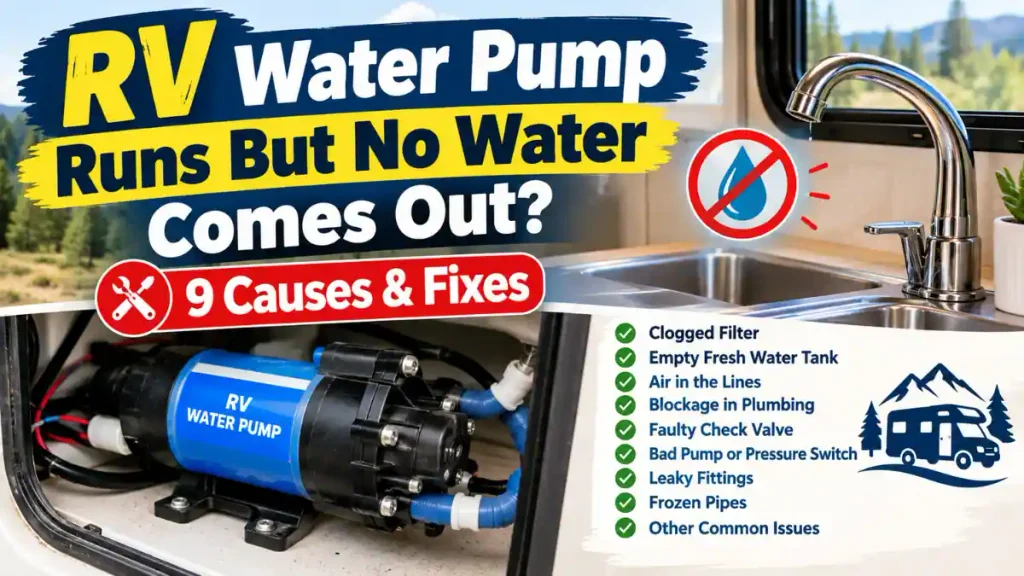
The most common causes are:
| Possible cause | What you may notice | What to check |
|---|---|---|
| Empty or very low fresh-water tank | Pump runs but faucets stay dry | Tank level |
| Clogged pump strainer | Pump runs with little/no flow | Strainer screen |
| Air leak on inlet side | Pump may sputter or fail to prime | Inlet fittings and hose |
| Kinked inlet hose | Pump runs continuously | Hose routing |
| Closed winterizing/bypass valve | No water reaches pump | Valve position |
| Restricted plumbing | Very weak or no flow | Hoses, valves and fittings |
| Air trapped in system | Sputtering faucets | Open faucets and bleed air |
| Debris in pump valves | Pump runs but cannot build pressure | Pump valve assembly |
| Low voltage at pump | Pump sounds weak or performs poorly | Voltage while pump is running |
The exact configuration varies between RVs and pump models, so use your pump’s manual when checking model-specific components.
1. Check the Fresh-Water Tank First
This sounds obvious, but it is one of the fastest things to eliminate.
If your RV is using the fresh-water tank as the water source, make sure there is actually water in the tank.
Turn on a faucet and listen to the pump.
If the pump runs continuously but the faucet remains completely dry, check the fresh-water tank level before taking the pump apart.
Also check whether the tank outlet or pickup line is blocked.
Pentair’s Shurflo troubleshooting information lists the presence of water in the tank and a clogged tank outlet among the checks for a pump that will not prime.
Quick test
- Turn the water pump off.
- Confirm the fresh-water tank has water.
- Turn the pump back on.
- Open the nearest cold-water faucet.
- Listen for changes in pump sound.
If the pump continues running with no water flow, continue to the next step.
2. Inspect the RV Water Pump Strainer
A clogged inlet strainer is one of the most common things to check when an RV pump runs but does not move water.
Many RV water pumps use a strainer on the inlet side to prevent debris from reaching the pump.
Over time, the screen can collect sediment or other material from the fresh-water tank.
Pentair’s Shurflo 4008 manual specifically recommends checking the strainer when the pump will not prime or sputters with the motor running.
How to check it
Turn the pump off before removing the strainer.
Then:
- Locate the strainer on the pump inlet.
- Carefully remove it according to the pump/strainer design.
- Inspect the screen for debris.
- Clean the screen.
- Reinstall the strainer and make sure the connection is secure.
- Turn the pump back on and test a faucet.
Important
Do not assume the pump itself has failed simply because it runs without producing water.
A blocked inlet can prevent the pump from getting enough water to prime.
3. Look for an Air Leak on the Pump’s Inlet Side
This is an important diagnostic step.
A water leak is not always necessary for an inlet-side problem.
The pump can potentially draw air through a loose or poorly sealed connection on the suction side without producing an obvious water leak.
Pentair lists an inlet plumbing connection that is sucking air through a vacuum leak as a possible cause of a Shurflo pump failing to prime.
Inspect:
- Pump inlet fitting
- Hose connection
- Strainer connection
- Hose clamps
- Threaded fittings
- Cracked or damaged inlet hose
- Any valve between the tank and pump
Pay particular attention to connections immediately before the pump.
What you’re looking for
If the pump runs but cannot establish a steady water flow, an inlet-side air leak is one of the things worth investigating before replacing the pump.
4. Check for a Kinked or Restricted Inlet Hose
The pump needs an unrestricted water supply from the fresh-water tank.
A hose that is sharply bent, collapsed or restricted can prevent enough water from reaching the pump.
Shurflo’s RV troubleshooting documentation lists kinked inlet hoses and restricted plumbing among possible causes of pump priming and low-flow problems.
Follow the plumbing from:
Fresh-water tank → tank outlet → hose → strainer → pump
Look for:
- Sharp bends
- Collapsed flexible hose
- Pinched hose
- Closed valve
- Blocked fitting
- Debris around the tank outlet
Fix the restriction and test the pump again.
5. Check the Winterizing Valve
If your RV has a winterizing/suction valve near the water pump, verify that it is in the correct position.
This valve is commonly used to draw RV antifreeze into the plumbing system during winterization.
If the valve is left in the wrong position, the pump may not receive water from the fresh-water tank as expected.
The Shurflo RV troubleshooting catalog identifies a clogged or restrictive winterizing valve as a possible cause of pump priming and low-flow problems.
What to do
Trace the inlet plumbing around the pump.
Identify any:
- Winterizing valve
- Tank shutoff valve
- Bypass valve
- Selector valve
Make sure the valve configuration matches your RV’s normal fresh-water operating position.
Because plumbing layouts differ, do not rely on the valve position from another RV as a guide.
6. Open a Faucet and Let the System Prime
If the pump has been sitting unused, air can be present in the plumbing.
Open a cold-water faucet and allow the pump to operate.
You may initially hear air moving through the system or see sputtering from the faucet.
Once water begins flowing consistently, allow the air to clear.
You can repeat this at another faucet if necessary.
Try this sequence
- Turn the water pump on.
- Open a cold-water faucet.
- Leave it open while the pump operates.
- Watch for air and water coming from the faucet.
- Close the faucet once steady water flow is established.
- Test another faucet.
If the pump continues running without producing any water, move to the inlet and pump checks rather than allowing the pump to run indefinitely.
7. Check for a Blocked Pump Valve
If the pump has good water supply but still will not produce water, debris inside the pump can become a possibility.
Shurflo’s troubleshooting documentation lists debris in the pump inlet/outlet valves and swollen or dry valves as possible causes of a pump that runs but will not prime.
This is a more advanced check.
Before opening the pump:
- Verify the fresh-water tank has water.
- Check the strainer.
- Check the inlet hose.
- Check for air leaks.
- Check valves and restrictions.
- Confirm the pump is receiving appropriate operating voltage.
Only then should you consider inspecting the pump assembly according to the manufacturer’s instructions.
8. Check Voltage at the Pump While It Is Running
A pump can receive power and still have a voltage-related performance problem.
For example, a voltage problem can become more noticeable when the pump is operating under load.
Shurflo’s RV pump manuals instruct users to check the operating voltage and electrical connections as part of troubleshooting. Some Shurflo models specify operating voltage checks within approximately ±10% of the nominal supply voltage.
If you are comfortable using a multimeter, check the voltage at the pump according to the manufacturer’s procedure.
Safety
You are dealing with a 12-volt electrical system and a water system at the same time.
Avoid creating a short circuit with meter probes or tools.
If you are not comfortable testing RV electrical circuits, have a qualified RV technician perform the voltage test.
9. The Pump Itself May Have an Internal Problem
If the tank has water, the inlet is unrestricted, the strainer is clean, there is no obvious air leak and the pump receives proper operating voltage, the pump itself becomes a stronger suspect.
Possible internal problems can include:
- Debris in the valves
- Damaged or swollen valves
- Diaphragm problems
- Pump-head problems
- Loose internal components
- Other model-specific mechanical issues
At this point, check the service information for your exact pump model.
Do not automatically replace the entire pump before confirming that the pump is actually the failed component.
How to Tell Where the Problem Is
A useful way to diagnose the problem is to divide the RV water system into three sections.
Section 1: Water Supply
Fresh-water tank → tank outlet → inlet hose
If water cannot reach the pump, the pump cannot produce normal flow.
Section 2: Pump
Strainer → pump inlet → pump → pump outlet
The pump must receive water and be able to move it through its internal valves.
Section 3: RV Plumbing
Pump outlet → water lines → faucets
If the pump can move water but the plumbing is restricted, you may have a downstream problem.
This approach prevents you from immediately blaming the pump.
RV Water Pump Runs But No Water: Quick Diagnostic Sequence
If you want the shortest troubleshooting path, use this order:
1. Check fresh-water tank level
↓
2. Check pump strainer
↓
3. Check inlet hose for kinks or restrictions
↓
4. Check inlet fittings for air leaks
↓
5. Check winterizing/selector valves
↓
6. Open a cold faucet and allow the system to purge air
↓
7. Check for blocked plumbing
↓
8. Check pump operating voltage
↓
9. Inspect the pump itself
This order starts with the easiest checks and moves toward more involved diagnosis.
What If the Pump Sputters Instead of Producing Water?
A sputtering pump is useful information.
It can indicate that the system is moving some air instead of establishing a steady water supply.
Possible areas to investigate include:
- Low tank water level
- Inlet-side air leak
- Restricted inlet
- Clogged strainer
- Tank outlet restriction
- Winterizing valve restriction
- Air trapped in the plumbing
Shurflo’s troubleshooting information specifically includes inlet air leaks, clogged strainers, restricted/kinked plumbing and tank-related issues among possible causes of failure to prime or sputtering.
Should You Replace the RV Water Pump?
Not yet—unless your troubleshooting has identified a pump failure.
Replacing the pump first can waste money if the real problem is:
- A clogged strainer
- A loose inlet connection
- A cracked inlet hose
- A closed valve
- A kinked hose
- A blocked tank outlet
- An electrical/voltage problem
A replacement pump should be considered when the water supply and plumbing have been checked and the pump itself has been shown to have an internal or mechanical problem.
Also make sure the replacement pump is appropriate for your RV’s plumbing system and electrical requirements.
Do not choose a replacement solely because it looks similar to the old pump.
Parts and Tools You May Need
Depending on what you find during diagnosis, useful items can include:
- Replacement RV water-pump strainer
- Correct-size hose
- Hose clamps
- Plumbing fittings
- Thread sealant appropriate for the fitting/application
- Digital multimeter
- Replacement water pump
- Manufacturer-specific pump repair kit, if available
Affiliate opportunity: This section is a natural place to add links to Amazon or other US RV-parts retailers after you decide which products you actually want to recommend.
For example, you could eventually create a small “Tools & Parts Used in This Fix” box containing:
- RV water pump strainer
- 12V digital multimeter
- Replacement inlet hose
- RV water pump
- Hose clamps
Avoid adding unrelated products just for affiliate links.
Safety Before Working on the Pump
Before removing plumbing or opening the pump:
- Turn the pump off.
- Disconnect power when performing electrical or pump disassembly work.
- Relieve water pressure where appropriate.
- Protect electrical connections from water.
- Follow the instructions for your exact pump model.
If you are unsure about electrical testing or pump disassembly, use an RV technician.
Frequently Asked Questions
Why does my RV water pump run but no water comes out?
The pump may not be receiving water from the fresh-water tank, may have a clogged strainer, may be drawing air through the inlet plumbing, or may have a restriction or internal valve problem. Start with the tank, strainer and inlet plumbing.
Why won’t my RV water pump prime?
Common possibilities include a clogged strainer, insufficient water in the tank, an inlet-side air leak, kinked or restricted plumbing, a restrictive valve, debris in the pump valves or an operating-voltage problem.
Can a clogged RV water-pump strainer stop water flow?
Yes. A restricted strainer can reduce or prevent the water supply reaching the pump. Shurflo specifically lists strainer blockage as a troubleshooting item for pumps that will not prime.
Can an RV water pump suck air without leaking water?
Yes. An inlet-side connection can potentially allow air into the suction side without producing an obvious water leak. Shurflo identifies inlet plumbing vacuum leaks as a possible cause of failure to prime.
Should I leave the RV water pump running if no water is coming out?
Do not simply let the pump run continuously while ignoring the problem. Shut it off and diagnose the water supply, inlet plumbing, strainer and other likely causes.
Does the RV water pump work with city water connected?
The exact plumbing arrangement varies by RV. In many systems, city water supplies the RV plumbing directly while the pump is used when drawing from the fresh-water tank. If the pump behaves unexpectedly while connected to city water, check your RV’s plumbing diagram and pump/manual instructions.
How do I know if my RV water pump is bad?
A pump becomes more suspect after you have confirmed that the fresh-water tank has water, the inlet is not restricted, the strainer is clear, there is no obvious inlet air leak, the valves are correctly positioned and the pump has appropriate operating voltage. At that point, inspect the pump according to its model-specific service information.
Final Takeaway
If your RV water pump runs but no water comes out, don’t start by buying a new pump.
Start at the beginning of the water path:
Tank → inlet hose → strainer → pump → plumbing → faucet
Check each section systematically.
The most useful first checks are the fresh-water tank, pump strainer, inlet hose, inlet air leaks and valve positions. If those are good, move on to restrictions, pump valves and operating voltage.
That approach can help you identify the actual failure instead of replacing a pump that may still be working.
Sources: Pentair/SHURFLO RV pump installation and troubleshooting documentation, including the SHURFLO 4008 and 4048 RV pump manuals.