An RV water pump should produce a steady, low mechanical hum when it runs. A noticeable clicking, rattling, buzzing, grinding, or vibrating sound usually means something needs attention. Sometimes the cause is simple, such as air trapped in the plumbing or a loose mounting screw. In other cases, the pump itself may be worn or damaged.
The good news is that a noisy RV water pump does not automatically mean you need a replacement. Many common problems can be identified with a few basic checks.
This guide explains why an RV water pump makes noise when running, how to identify the type of noise, and what you can do to fix it.
What Noise Is Normal for an RV Water Pump?
Most RV water pumps are diaphragm pumps powered by 12-volt DC electricity. They use an electric motor and internal diaphragm mechanism to move water through the plumbing system.
A normal pump may produce:
- A soft humming sound
- A moderate clicking or pulsing sound
- A short burst of noise when a faucet is opened
- A brief run after the faucet is closed while pressure builds
The pump should normally stop once the system reaches its pressure setting.
A problem is more likely when the sound suddenly becomes louder or changes to a grinding, rattling, squealing, buzzing, or harsh vibrating noise.
Common Types of RV Water Pump Noise
The type of sound can provide a useful clue.
Humming or Buzzing
A low hum can be normal, but excessive buzzing may indicate:
- Electrical problems
- A struggling motor
- Low voltage
- A restricted water supply
- A damaged pump motor
Rattling
Rattling often comes from vibration rather than an internal pump failure.
Check for:
- Loose mounting screws
- Loose plumbing connections
- Pump touching a cabinet or wall
- Loose wires
- A damaged mounting bracket
Clicking
Some clicking is normal because diaphragm pumps operate with a pulsating pumping action.
However, rapid clicking that continues while no faucet is open can indicate:
- A leak
- A faulty check valve
- Pressure loss
- Air entering the water system
Grinding
Grinding is more concerning.
It can indicate:
- Worn motor bearings
- Internal pump damage
- Debris inside the pump
- A failing motor
If the grinding is severe, continued operation can make the damage worse.
Squealing or Screeching
A high-pitched squeal may point toward:
- Motor bearing wear
- Mechanical friction
- A damaged internal component
- Excessive pump load
A squealing pump deserves inspection rather than being ignored.
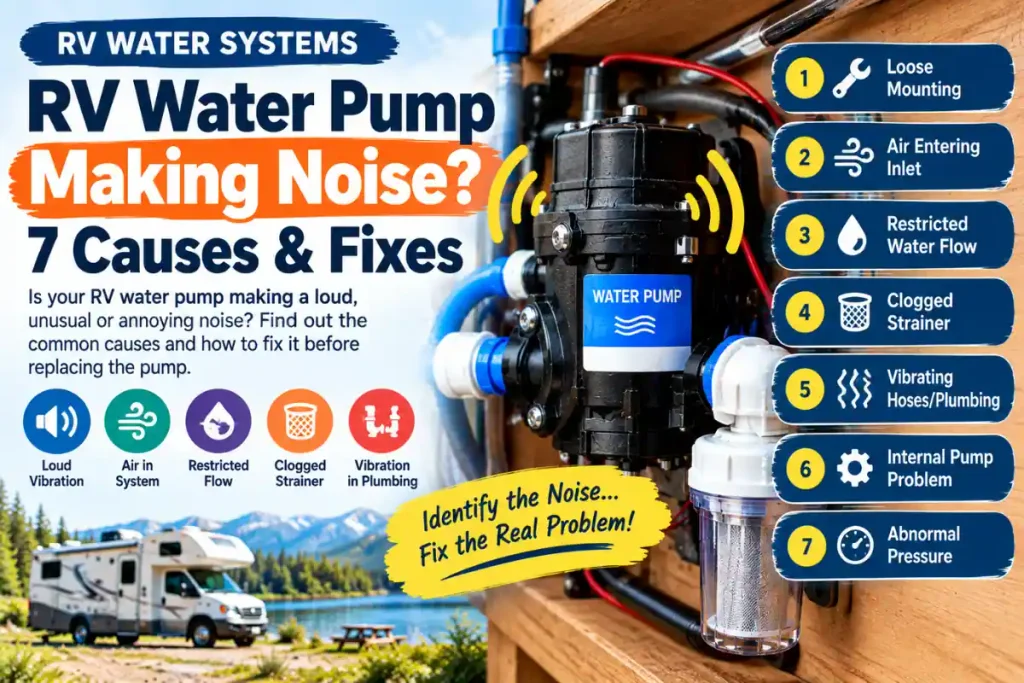
10 Reasons Your RV Water Pump Is Making Noise
1. The Pump Is Vibrating Against Its Mount
One of the simplest explanations is excessive vibration.
The pump motor naturally creates some movement while operating. If the pump is mounted directly against a hard cabinet surface, floor, wall, or frame, that vibration can become much louder.
How to check it
Turn on a faucet and watch the pump while it runs.
Look for:
- Excessive movement
- Loose mounting screws
- Contact between the pump and surrounding surfaces
- Cracked or compressed mounting material
Fix
Tighten the mounting screws, but don’t overtighten them.
If the pump is mounted rigidly against a hard surface, rubber isolation pads can help reduce vibration. Flexible sections of water tubing can also prevent pump vibration from being transferred through the plumbing.
2. Air Is Trapped in the Water Lines
Air in the plumbing system can make an RV water pump sound unusually loud.
The pump may run with a rapid pulsing or rattling sound as it attempts to move a mixture of air and water.
This can happen after:
- Filling the fresh-water tank
- Draining the plumbing
- Winterizing the RV
- Replacing a filter
- Performing plumbing repairs
Fix
Open a faucet and allow the pump to run.
Start with the faucet closest to the pump and then open the other faucets one at a time. Allow water to flow until the sputtering stops and the stream becomes steady.
Don’t let the pump run dry for an extended period.
3. The Fresh-Water Tank Is Nearly Empty
An RV water pump needs an adequate water supply. If the fresh-water tank is nearly empty, the pump may pull air into the system.
This can cause:
- Loud pulsing
- Irregular clicking
- Increased vibration
- Reduced water pressure
Fix
Check the fresh-water tank level before investigating more complicated causes.
If the tank is low, add enough water and test the pump again.
If the noise disappears, the pump may have simply been struggling because of insufficient water.
4. The Pump Is Starved for Water
A full tank doesn’t always mean the pump is receiving enough water.
A restriction between the fresh-water tank and pump can reduce water flow.
Possible causes include:
- Blocked inlet strainer
- Kinked hose
- Collapsed hose
- Dirty filter
- Restricted tank outlet
- Damaged suction line
The pump may become noticeably louder because it is trying to pull water through the restriction.
Inspect the inlet side
Follow the water line from the fresh-water tank toward the pump.
Check for:
- Kinks
- Crushed tubing
- Loose connections
- Dirty strainers
- Blockages
A transparent inlet section, if installed, can sometimes help reveal air bubbles.
5. The Pump’s Inlet Strainer Is Dirty
Many RV water pump installations include a small inlet strainer or filter.
Its purpose is to prevent debris from entering the pump.
Over time, it can collect:
- Sediment
- Plastic particles
- Tank debris
- Mineral deposits
- Other contaminants
A clogged strainer restricts water entering the pump and can increase noise.
How to clean it
Turn off the pump and disconnect its power.
Relieve water pressure before opening the strainer.
Remove the strainer bowl according to the manufacturer’s instructions and clean the screen.
Inspect the O-ring before reinstalling it. A damaged or poorly seated O-ring can allow air to enter the suction side.
6. There Is a Water Leak Somewhere in the RV
A pump that keeps clicking or cycling when every faucet is closed may be responding to pressure loss.
The leak may be obvious, but some leaks are hidden.
Check:
- Faucet connections
- Shower fittings
- Toilet valve
- Outdoor shower
- Water heater connections
- Under-sink plumbing
- PEX fittings
- Pump connections
- Water filter housing
- Low-point drain valves
A simple test
Make sure all faucets are closed.
Turn the pump on and allow it to reach pressure.
The pump should normally shut off.
If it continues running or periodically starts again without water being used, investigate for a leak or pressure-loss problem.
7. The Pump Is Running at Low Voltage
RV water pumps are usually designed to operate on the RV’s 12-volt electrical system.
Low voltage can cause the motor to operate poorly.
Symptoms can include:
- Weak water pressure
- Slow pump operation
- Unusual humming
- Increased motor noise
- Difficulty starting
- Excessive cycling
Low voltage can result from:
- Weak battery
- Poor battery connections
- Corroded terminals
- Long undersized wiring
- Poor ground connection
- A problem with the RV’s electrical system
What to do
If you have a suitable multimeter and know how to use it safely, check voltage at the pump while it is running.
Don’t assume the battery voltage is identical to the voltage actually reaching the pump.
A significant voltage drop between the power source and pump can point to a wiring or connection problem.
8. The Pump Is Mounted Incorrectly
Pump orientation and installation can affect vibration and noise.
The exact mounting requirements vary by pump manufacturer, so follow the instructions supplied with your model.
Avoid installations where:
- The pump body is forced against another surface
- Tubing is stretched tightly
- Plumbing puts sideways pressure on the pump
- Mounting screws distort the pump base
- The pump is installed without appropriate vibration isolation
Flexible water lines can help prevent vibration from being transmitted through rigid plumbing.
9. Debris Has Entered the Pump
Small particles can sometimes get past a damaged, missing, or poorly maintained inlet strainer.
Debris inside the pump can interfere with normal diaphragm or valve operation.
You may hear:
- Clicking
- Rattling
- Grinding
- Irregular pulsing
Before opening the pump itself, inspect the inlet strainer and plumbing.
If the pump requires internal disassembly, follow the manufacturer’s service instructions. Opening the pump unnecessarily can create additional problems or affect warranty coverage.
10. The Pump Motor or Internal Components Are Worn
If you’ve ruled out air, restrictions, mounting problems, leaks, and electrical issues, the pump itself may be approaching the end of its service life.
A worn pump may become progressively louder.
Warning signs include:
- Grinding
- Screeching
- Reduced water pressure
- Longer run times
- Frequent cycling
- Failure to shut off
- Motor overheating
- Water leaking from the pump
- Noise that has steadily increased over time
At that point, replacement may be more practical than attempting a repair, particularly if replacement parts or a rebuild kit are unavailable for the specific pump.
How to Diagnose a Noisy RV Water Pump
You don’t need to immediately remove the pump.
Use this simple troubleshooting sequence.
Step 1: Identify the Noise
Listen carefully.
Is it:
- Humming?
- Clicking?
- Rattling?
- Grinding?
- Squealing?
- Vibrating?
The sound provides the first clue.
Step 2: Check the Fresh-Water Tank
Make sure there is sufficient water in the tank.
If the tank is empty or nearly empty, refill it and test the pump.
Step 3: Open a Faucet
Open a faucet and allow water to flow.
If the noise decreases once water flows continuously, trapped air or normal pressure cycling may be involved.
Step 4: Check the Inlet Strainer
Turn off the pump and disconnect power before servicing the strainer.
Inspect it for debris and restrictions.
Step 5: Inspect the Pump Mount
Look for loose screws or contact between the pump and surrounding surfaces.
Try to determine whether the noise is mechanical or simply vibration being transferred into the RV structure.
Step 6: Check for Leaks
Close every faucet and turn the pump on.
After it reaches pressure, it should normally stop.
If it keeps cycling, look for pressure loss.
Step 7: Check Electrical Connections
Inspect accessible wiring for:
- Loose terminals
- Corrosion
- Damaged insulation
- Poor ground connections
If you suspect low voltage, test the voltage at the pump while it is operating.
When Should You Replace an RV Water Pump?
Noise alone doesn’t mean the pump needs replacement.
Replacement becomes more likely when the pump has multiple symptoms, such as:
- Loud grinding
- Persistent squealing
- Poor water pressure
- Frequent cycling
- Failure to shut off
- Overheating
- Visible physical damage
- Water leaking from the pump body
- Repeated electrical problems
If the pump is relatively new, check its warranty and installation requirements before purchasing a replacement.
How to Prevent RV Water Pump Noise
Regular maintenance can prevent many noise problems.
Keep the fresh-water system clean
Periodically inspect the tank, hoses, strainer, and plumbing.
Clean the inlet strainer
Don’t wait until water pressure drops. Inspect the strainer as part of routine RV maintenance.
Protect the pump from excessive vibration
Use appropriate mounting hardware and vibration isolation where recommended.
Avoid running the pump dry
Don’t operate the pump for long periods without an adequate water supply.
Check for leaks
A small leak can cause repeated pump cycling and unnecessary wear.
Maintain the RV electrical system
Keep battery terminals and pump connections clean and secure.
Winterize correctly
Water-system damage from freezing can affect pumps, hoses, fittings, and other components.
Is It Safe to Keep Using a Noisy RV Water Pump?
It depends on the noise.
A slightly louder hum or normal diaphragm clicking may not indicate a serious problem.
However, grinding, burning smells, severe vibration, overheating, or electrical arcing should not be ignored.
Turn the pump off and investigate the cause before continued use.
If electrical wiring appears damaged or overheated, disconnect power and have the electrical system inspected rather than continuing to operate the pump.
Quick RV Water Pump Noise Troubleshooting Chart
| Noise or Symptom | Possible Cause | First Check |
|---|---|---|
| Loud humming | Low voltage, motor strain | Electrical supply |
| Rattling | Loose mounting or plumbing | Mounting screws |
| Rapid clicking | Leak or pressure loss | Faucets and fittings |
| Pulsing | Air or restricted water supply | Tank and inlet |
| Grinding | Internal wear or debris | Pump condition |
| Squealing | Motor/mechanical wear | Pump motor |
| Pump won’t stop | Leak or pressure issue | Entire water system |
| Weak pressure + noise | Restriction or failing pump | Strainer and inlet |
| Noise after tank refill | Air in lines | Purge faucets |
| Increasing noise over time | Wear | Pump inspection |
Final Thoughts
An RV water pump making noise when running is often caused by something simple: vibration, air in the plumbing, a dirty inlet strainer, low tank level, or a restricted water supply. These problems can usually be checked before considering pump replacement.
Start with the easiest possibilities. Check the water level, purge air from the lines, inspect the inlet strainer, look for leaks, and examine the pump’s mounting.
If the noise is accompanied by grinding, overheating, poor pressure, or repeated cycling, take the problem more seriously. A failing pump can eventually leave you without reliable water pressure, so diagnosing the noise early is usually cheaper and easier than waiting for complete failure.