If your RV water pump runs but never builds enough pressure to shut off, the problem is usually somewhere between the fresh-water tank, pump inlet, pump valves, and the pressurized plumbing system.
You may notice that the pump keeps running, water pressure stays weak, or the pump turns on repeatedly even when the faucets are closed.
Before replacing the pump, work through the system in order. A clogged strainer, air leak on the inlet side, restricted plumbing, low operating voltage, leaking faucet or toilet valve, or a problem inside the pump can all produce similar symptoms.
Quick Answer
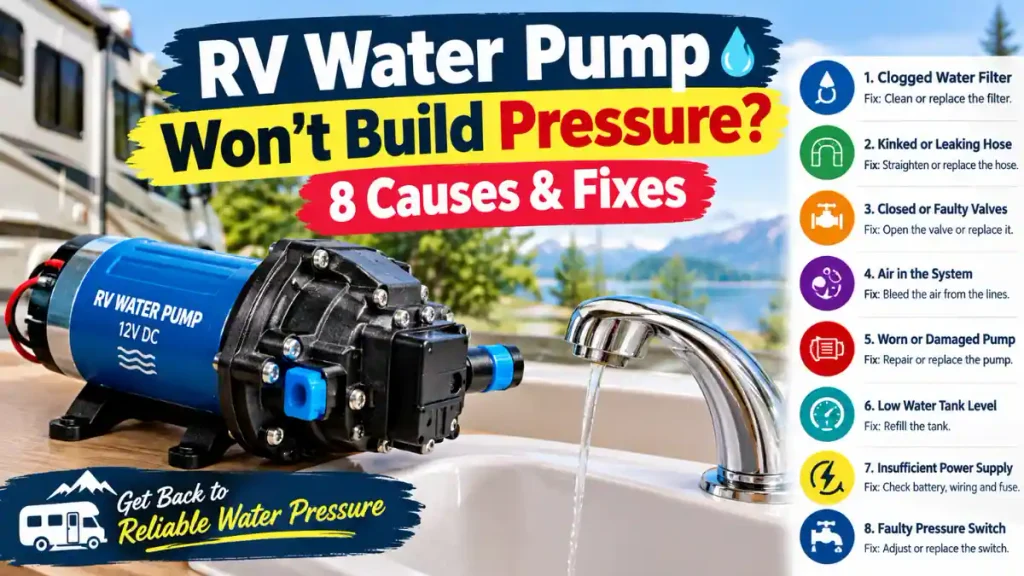
An RV water pump that won’t build pressure can be caused by:
- A clogged pump strainer
- An air leak on the pump inlet side
- A restricted or kinked inlet hose
- Low water level or an improperly positioned valve
- A leak on the pressurized side
- Debris or damaged pump valves
- Low voltage at the pump while it is running
- A failing pressure switch, diaphragm, or pump assembly
The important point is that a pump running continuously does not automatically mean the pump itself is bad.
Start with the water supply and plumbing before replacing the pump.
If your RV water pump runs but no water comes out at all, start with the water-supply and priming checks in our guide: RV Water Pump Runs But No Water Comes Out? 9 Causes & Fixes.
How an RV Water Pump Builds Pressure
Most RV demand water pumps work by drawing water from the fresh-water tank and pressurizing the RV’s plumbing.
When a faucet is opened, system pressure drops. The pump starts and supplies water.
When the faucet is closed and the system reaches the pump’s shut-off pressure, the pump should stop.
The exact pressure varies by pump model. For example, Pentair lists a 30 PSI shut-off pressure for its SHURFLO SLV pump, while its SHURFLO 4048 pump is listed with a 55 PSI shut-off pressure. Always use the specifications for the actual pump installed in your RV rather than assuming every RV pump has the same pressure setting.
That gives us an important diagnostic clue:
If the pump runs but cannot reach its normal shut-off pressure, either pressure is being lost somewhere or the pump cannot generate the required pressure.
1. Check the Pump Strainer
The pump’s inlet strainer is one of the first things to inspect.
The strainer protects the pump from debris coming from the fresh-water tank. If it becomes clogged, the pump may not receive enough water to build normal pressure.
What to check
Turn off the pump and inspect the clear strainer housing, if your pump has one.
Look for:
- Dirt
- Tank debris
- Sediment
- Small particles
- Restricted water flow
SHURFLO troubleshooting documentation specifically lists a clogged strainer as a possible cause of a pump that will not prime or produces no discharge while the motor is running.
What to do
Clean the strainer according to the pump manufacturer’s instructions and reinstall it securely.
Then run the pump again and check whether pressure improves.
If pressure returns after cleaning the strainer, the pump may not have been the problem at all.
2. Check for an Air Leak on the Pump Inlet Side
This is an important distinction:
An inlet-side air leak may not produce an obvious water leak.
The pump is operating under suction on the inlet side. A loose fitting, damaged hose, poor connection or other problem can allow air to enter the system.
The result can be:
- Pump runs continuously
- Water flow is weak
- Faucet sputters
- Pump struggles to prime
- Pressure never reaches normal shut-off pressure
SHURFLO troubleshooting instructions specifically recommend checking the inlet plumbing for air being pulled into the system through a vacuum leak.
What to inspect
Start at the fresh-water tank and follow the line toward the pump.
Check:
- Hose connections
- Clamps
- Threaded fittings
- Strainer connections
- Cracked tubing
- Loose fittings
Do not only look for water dripping out.
An inlet-side problem can allow air into the pump without producing an obvious external water leak.
3. Inspect the Inlet Hose for Kinks or Restrictions
The pump cannot build proper pressure if its water supply is restricted.
Look at the hose between the fresh-water tank and pump.
Check for:
- Sharp bends
- Kinks
- Collapsed flexible hose
- Restricted fittings
- Closed valves
- Debris inside the plumbing
SHURFLO manuals list severely restricted or kinked inlet/outlet plumbing and restrictive valves among the causes of priming and pressure problems.
Simple diagnostic idea
Follow the water path from:
Fresh-water tank → inlet valve → hose → strainer → pump
The goal is to find the first point where water flow becomes restricted.
4. Make Sure the Fresh-Water System Is Actually Supplying Water
Before diagnosing the pump, verify that water is available to it.
Check the fresh-water tank level and make sure the appropriate valves are positioned correctly for your RV’s plumbing configuration.
Also check whether the RV has a winterizing or siphon valve arrangement that could be drawing air instead of water.
A pump can sound completely normal while failing to build pressure simply because it is not receiving a proper water supply.
Quick test
Open a cold-water faucet and observe the flow.
If the pump runs but the faucet produces little or no water, concentrate first on the tank → inlet → strainer → pump side of the system.
Do not immediately adjust the pressure switch or replace the pump.
5. Check for a Water Leak After the Pump
If the pump can produce pressure but the pressure is constantly escaping, it may continue running.
The leak does not necessarily have to be a large visible leak.
Check:
- Faucets
- Shower valve
- Toilet valve
- Outside shower
- Water heater connections
- PEX fittings
- Pump outlet fittings
- Filter housings
- Other pressurized plumbing connections
A toilet valve that does not fully close can be enough to prevent the system from reaching shut-off pressure.
A useful test
Close every faucet and fixture.
Turn the pump on and wait.
If the pump continues running, listen and inspect the RV for water movement or a hidden leak.
If you can safely isolate sections of the plumbing, do so and observe whether pump behavior changes.
6. Check the Pump’s Internal Valves
If the water supply is good, the inlet is not restricted, and there are no obvious leaks, the problem may be inside the pump.
Pump valves can be affected by:
- Debris
- Mineral deposits
- Swelling
- Damage
- Contamination
SHURFLO troubleshooting documentation identifies debris in the inlet/outlet valves and swollen or damaged valves as possible causes of poor priming and failure to shut off.
This is especially worth considering when:
- The pump has been used for a long time
- The strainer has been dirty
- The pump has been exposed to contamination
- The RV water system has not been properly maintained
- The pump suddenly changed from normal operation to continuous running
Before opening the pump
Check the manufacturer’s manual for your exact model.
Pump construction and service procedures differ between models.
Do not assume that a repair procedure for one SHURFLO pump applies to every RV pump.
7. Measure Voltage at the Pump While It Is Running
A pump can have power and still have a voltage problem under load.
This is why checking voltage only when the pump is switched off may not tell you enough.
SHURFLO documentation calls for checking correct operating voltage at the pump and notes a ±10% voltage guideline in its troubleshooting information.
What to check
With the pump running, measure the voltage at the pump according to the manufacturer’s instructions.
Look for:
- Weak battery
- Poor ground connection
- Corroded terminals
- Loose wiring
- Excessive voltage drop
- Undersized wiring
- Charging-system problems
If the voltage drops significantly when the pump is operating, investigate the electrical supply before blaming the pump.
Safety
If you are not comfortable testing a 12-volt electrical circuit with a multimeter, have a qualified RV technician perform the test.
8. The Pressure Switch or Pump Assembly May Be the Problem
If you have confirmed:
- Water is reaching the pump
- The strainer is clean
- The inlet is not restricted
- There is no obvious inlet air leak
- There is no downstream leak
- The pump has proper operating voltage
- The pump still cannot reach its normal shut-off pressure
then the pump assembly itself becomes a stronger suspect.
Depending on the pump design, possible problems can involve:
- Pressure switch
- Diaphragm
- Valve assembly
- Drive assembly
- Pump head
- Internal bypass system
Some SHURFLO models use pressure switches, while other models incorporate different pump-control designs. The exact diagnostic procedure therefore depends on the pump model.
Do not adjust a pressure switch blindly.
First determine the pump model and check its manufacturer’s specifications and service instructions.
RV Water Pump Won’t Build Pressure: Diagnostic Order
Instead of replacing parts randomly, work through the system in this order:
| Check | What you’re looking for | If the result is bad |
|---|---|---|
| Fresh-water tank | Adequate water supply | Correct tank/valve condition |
| Strainer | Dirt or blockage | Clean/replace as appropriate |
| Inlet hose | Kink or restriction | Repair/replace restriction |
| Inlet connections | Air entering system | Tighten/repair connection |
| Pressurized plumbing | Water leak | Repair leak |
| Fixtures | Faucet/toilet/shower leak | Repair fixture |
| Pump voltage | Low voltage under load | Diagnose wiring/battery |
| Pump valves | Debris/damage | Service according to model |
| Pressure control | Correct pump operation | Follow model-specific procedure |
This sequence matters because it moves from the easiest external checks toward the more involved pump diagnosis.
A Simple RVFixGuide Test
If your RV pump runs continuously and you are trying to decide whether the pump itself is bad, use this basic logic:
Step 1 — Is water reaching the pump?
If no:
Tank → valve → hose → strainer → inlet connection
Find the restriction or air leak.
Step 2 — Is water leaving the pump?
If no:
Inspect the pump’s valves, restrictions and internal components according to the manufacturer’s instructions.
Step 3 — Is pressure escaping after the pump?
If yes:
Find the leak or fixture that is consuming water.
Step 4 — Is the pump receiving proper voltage while running?
If no:
Fix the electrical supply problem.
Step 5 — Everything checks out but pressure still remains low?
At this point, the pump itself becomes a more reasonable suspect.
This approach can prevent replacing a perfectly good pump when the actual problem is a fitting, strainer, hose or plumbing leak.
When Should You Replace the RV Water Pump?
Do not replace the pump simply because it runs continuously.
Replacement becomes more reasonable when testing shows that:
- Water supply to the pump is good
- The inlet is unrestricted
- There are no significant air leaks
- Downstream plumbing is not leaking
- Operating voltage is correct
- The pump still cannot produce its specified pressure
- Internal pump components are damaged or worn
- The manufacturer recommends replacement rather than service for your particular model
The exact replacement decision should be based on the pump model and its manufacturer’s specifications.
Don’t Confuse These Two Problems
There is an important difference between:
Pump won’t build pressure
The pump runs but never reaches its normal pressure.
Possible causes include:
- Inlet restriction
- Air leak
- Internal valve problem
- Low voltage
- Pump failure
Pump builds pressure but won’t shut off
The pump reaches pressure but continues running.
Possible causes include:
- Plumbing leak
- Leaking toilet or faucet
- Air trapped in the system
- Valve problem
- Pressure-switch/control problem
These symptoms overlap, but they are not always the same failure.
If the pump builds pressure but keeps running after the faucets are closed, see our guide to RV Water Pump Keeps Running.
Safety Before Troubleshooting
Before working on the pump:
- Turn the pump off before disconnecting plumbing.
- Relieve water pressure before opening fittings.
- Disconnect electrical power when servicing electrical connections or removing the pump.
- Follow the manufacturer’s instructions for your specific pump.
- Never bypass electrical protection unless the manufacturer specifically instructs you to do so.
- If you are unsure about 12-volt electrical testing, use a qualified RV technician.
Frequently Asked Questions
Why does my RV water pump run but not build pressure?
Common causes include a clogged strainer, air entering through the pump inlet, restricted plumbing, insufficient water supply, a downstream leak, low operating voltage, internal valve problems or a pump-control problem.
Can a clogged filter cause an RV water pump to lose pressure?
Yes. A restricted strainer or filter can limit the amount of water reaching the pump. SHURFLO troubleshooting documentation specifically identifies a clogged strainer as a possible cause of priming and discharge problems.
Can an air leak make an RV water pump run continuously?
Yes. An inlet-side air leak can prevent the pump from getting a solid water supply, while an outlet-side leak can allow pressure to escape. The two situations require different checks.
Should I adjust the RV water pump pressure switch?
Not as a first step. Determine the pump model and follow its manufacturer-specific procedure. Different RV pumps have different pressure specifications and control systems.
How do I know if my RV water pump is bad?
First eliminate the external causes: water supply, strainer, inlet restriction, air leaks, plumbing leaks and operating voltage. If those checks are good and the pump still cannot reach its specified pressure, the pump assembly becomes a stronger suspect.
Can low RV battery voltage affect water pump pressure?
Yes. A pump that is not receiving proper operating voltage can have performance problems. Check voltage at the pump while it is operating rather than assuming the battery or wiring is fine.
Final Takeaway
An RV water pump that won’t build pressure does not automatically need to be replaced.
Start at the beginning of the water path:
Fresh-water tank → inlet plumbing → strainer → pump → pressurized plumbing → fixtures
Check each section before moving to the next.
If the water supply is good, the plumbing is not leaking or restricted, the pump has proper operating voltage, and it still cannot reach its specified pressure, then investigate the pump’s valves, pressure control and internal components.
Diagnose the system before replacing the pump.
Manufacturer References
- Pentair / SHURFLO 4008 RV By-Pass Pump troubleshooting documentation
- Pentair / SHURFLO 4048 RV By-Pass Pump troubleshooting documentation
- Pentair / SHURFLO RV pump installation and troubleshooting documentation
Manufacturer documentation was used to verify the troubleshooting points in this guide, including strainer restrictions, inlet air leaks, kinked plumbing, valve problems, operating voltage and pressure-control issues.