If your RV water pump keeps running after you turn on the faucet, the pump may not be reaching its shut-off pressure. In many cases, the problem is caused by a small water leak, trapped air, a clogged strainer, a faulty check valve, or a pressure-setting issue.
Before replacing the pump, check the water supply, faucets, valves, plumbing connections and pump inlet. A few simple tests can often identify the problem.
Quick Answer
An RV water pump that keeps running is usually caused by one of these problems:
- A faucet or water fixture is still slightly open
- There is a leak somewhere in the plumbing
- The fresh-water tank is low or empty
- Air is entering the pump inlet
- The pump strainer is clogged
- A water line is kinked or restricted
- The pump’s internal check valve is not holding pressure
- The pump is not properly primed
- The pump pressure switch is not shutting the motor off
Start by turning off every faucet and water fixture. If the pump continues running, inspect the system for pressure loss before assuming the pump itself has failed.
Why Does an RV Water Pump Keep Running?
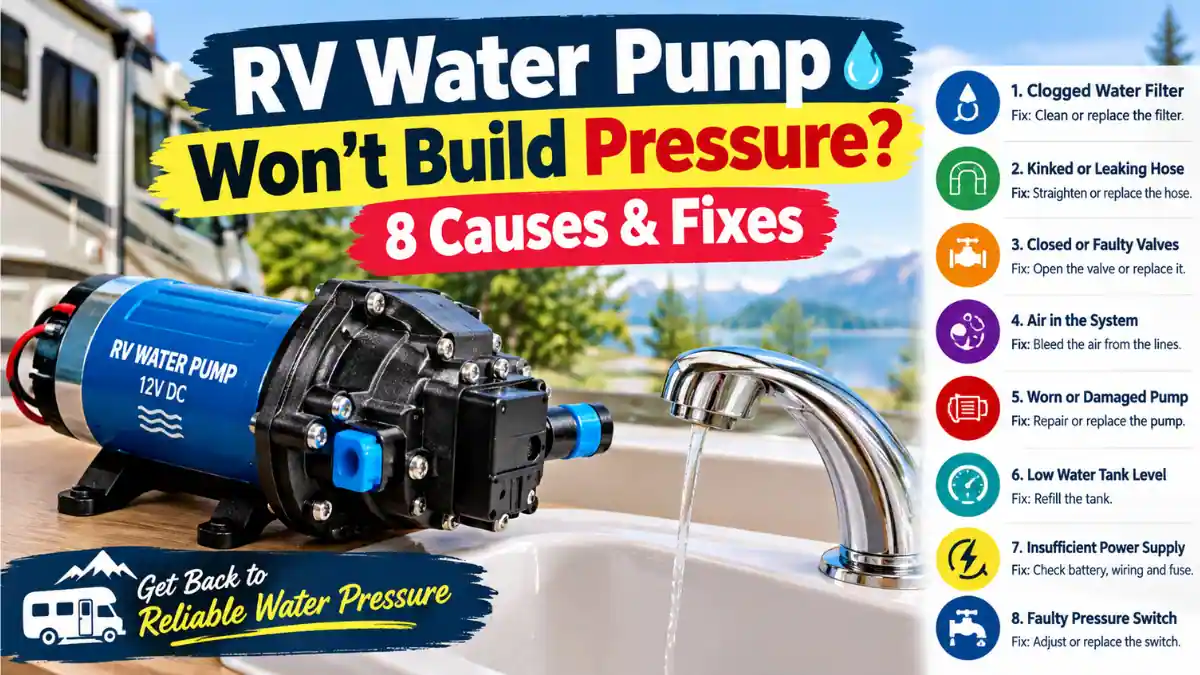
An RV water pump is designed to build water pressure and then shut itself off automatically.
When you open a faucet, pressure in the plumbing system drops. The pump starts and supplies water until the system reaches its shut-off pressure.
If the pump continues running after all faucets are closed, something is preventing the system from reaching or maintaining the required pressure.
The important question is:
Is the pump continuously running because water is escaping, or because the pump cannot build pressure?
That distinction can save you from replacing a perfectly good pump.
1. A Faucet Is Still Slightly Open
The simplest cause is also one of the easiest to overlook.
A faucet may appear closed but still allow a small amount of water to pass. The same can happen with an exterior shower, bathroom fixture or another water outlet.
What to check
Turn off:
- Kitchen faucet
- Bathroom faucet
- Shower
- Exterior shower
- Any water filter bypass or fixture that can allow flow
- Any other RV water outlet
Then listen to the pump.
What the result means
If the pump shuts off after closing a fixture, the pump may be working normally.
If it continues running, move to the next check.
2. There Is a Water Leak
A small plumbing leak can continuously reduce system pressure.
The leak may not always produce an obvious puddle. Water can leak inside a cabinet, around a fitting, behind a fixture or underneath the RV.
Check these areas
Look around:
- Water pump connections
- Fresh-water lines
- Faucet connections
- Toilet supply line
- Shower connections
- Water heater connections
- Exterior shower
- Water filter housing
- Plumbing fittings underneath sinks
- Areas where PEX tubing connects to fittings
Dry the suspicious area with a paper towel and check again after the pump has been running.
Important
A very small leak may be enough to keep the pump cycling or running.
Fix the leak before replacing the pump.
3. The Fresh-Water Tank Is Low or Empty
The pump needs an adequate water supply from the fresh-water tank when operating in normal tank mode.
If the tank is nearly empty, the pump may not receive enough water to build proper pressure.
Check the tank
Verify the fresh-water tank has water in it.
If the tank is empty or very low:
- Turn the pump off.
- Add fresh water according to the RV manufacturer’s instructions.
- Open a faucet briefly.
- Allow the system to purge air.
- Close the faucet.
- Check whether the pump shuts off.
If the pump works normally after the tank is filled, the water supply was likely the issue.
4. Air Is Entering the Pump Inlet
Air entering the pump’s inlet side can prevent the pump from building stable pressure.
This can happen because of:
- A loose inlet fitting
- Damaged tubing
- A cracked connection
- A poor seal
- A loose strainer connection
- A damaged O-ring
Unlike a pressure-side leak, an inlet-side air leak may not leave water on the floor.
How to check
Inspect the plumbing between the fresh-water tank and pump.
Pay particular attention to the pump’s inlet fittings and strainer.
If tightening or resealing a connection solves the problem, the pump itself may not need replacement.
5. The Pump Strainer Is Clogged
Many RV water pumps use an inlet strainer to prevent debris from entering the pump.
If the strainer becomes restricted, the pump may have difficulty getting enough water.
A restricted inlet can contribute to poor flow and difficulty reaching shut-off pressure.
Check the strainer
Turn the pump off before servicing the strainer.
Inspect it for:
- Dirt
- Sediment
- Plastic debris
- Mineral deposits
- Other material restricting water flow
Clean the strainer according to the pump manufacturer’s instructions.
Make sure the strainer is correctly reassembled and its seal is seated properly.
6. A Water Line Is Kinked or Restricted
A kinked or restricted water line can reduce flow and prevent the pump from operating normally.
This is particularly worth checking if the problem started after plumbing work, storage, modification or maintenance.
Inspect the lines
Follow the water line from the pump and look for:
- Sharp bends
- Kinks
- Crushed tubing
- Pinched sections
- Damaged fittings
- Restrictions near connections
Correct any obvious restriction and test the system again.
7. The Pump’s Check Valve Is Not Holding Pressure
An RV water pump uses internal components that help maintain pressure after the pump stops.
If the pump builds pressure but pressure then falls back through the pump, the motor may restart or continue operating.
This can happen because of debris, wear or a problem with the pump’s internal check valve.
A useful clue
If the pump:
Runs → stops briefly → starts again → repeats
you may be dealing with pressure loss rather than a motor that simply cannot stop.
First rule out external leaks and plumbing problems.
If everything outside the pump checks out, consult the pump manufacturer’s service information to determine whether the pump’s internal valve can be serviced or whether the pump should be replaced.
8. The Pump Has Not Been Properly Primed
Air trapped in the water system can sometimes prevent an RV pump from establishing normal pressure.
This can happen after:
- Draining the RV
- Winterization
- Replacing plumbing
- Installing a new pump
- Running the fresh-water tank empty
What to do
Make sure the fresh-water tank contains enough water.
Then:
- Turn the pump on.
- Open a faucet.
- Allow water and trapped air to come through the fixture.
- Keep the faucet open until the flow becomes steady.
- Close the faucet.
- Listen for the pump to shut off.
If the pump still cannot establish pressure, continue with the remaining checks.
Always follow the pump manufacturer’s priming instructions when available.
9. The Pressure Switch Is Not Shutting the Pump Off
If the plumbing system is not leaking and the pump can produce adequate water flow, the pressure switch may be part of the problem.
The pressure switch controls when the pump starts and stops based on system pressure.
A faulty, damaged or incorrectly adjusted switch can prevent normal shut-off.
Before blaming the pressure switch
Check these first:
- Fresh-water supply
- Pump inlet
- Strainer
- Plumbing leaks
- Faucets and fixtures
- Air entering the inlet
- Kinked water lines
- Pump check valve
If those areas are okay, consult the pump manufacturer’s specifications before adjusting or replacing the pressure switch.
Do not randomly adjust the pressure switch. The correct pressure settings vary by pump model.
RV Water Pump Keeps Running: Quick Diagnostic Table
| What you observe | Possible cause | What to check |
|---|---|---|
| Pump runs continuously with faucet closed | Plumbing leak | Inspect all visible plumbing |
| Pump runs after tank becomes empty | Low water supply | Check fresh-water tank |
| Pump runs and flow is weak | Restricted inlet | Check strainer and inlet |
| Pump cycles repeatedly | Pressure loss | Check leaks and check valve |
| Pump runs after winterization | Air in system | Prime and purge air |
| Pump runs after plumbing work | Loose connection | Inspect fittings and tubing |
| Pump runs but pressure is weak | Restricted supply | Check inlet and water lines |
| Pump runs normally with faucet open but won’t shut off | Pressure problem | Check leaks, check valve and pressure switch |
| Pump has good flow but won’t reach shut-off | Pressure switch or internal pump issue | Check manufacturer specifications |
How to Diagnose an RV Water Pump That Won’t Shut Off
Use this sequence instead of immediately replacing the pump.
Step 1: Close every faucet
Make sure every water outlet is completely closed.
Step 2: Turn off unnecessary fixtures
Check the shower and exterior shower as well.
Step 3: Check the fresh-water tank
Make sure the pump has an adequate water supply.
Step 4: Inspect for leaks
Look underneath sinks, around fittings and near the pump.
Step 5: Inspect the pump inlet
Check the tubing, fittings and strainer.
Step 6: Check for air
Look for loose inlet connections or damaged seals that could allow air into the pump.
Step 7: Check the water lines
Look for kinks or restrictions.
Step 8: Observe the pump behavior
Does it:
- Run continuously?
- Stop and restart?
- Run for a long time before stopping?
- Produce weak water flow?
The behavior can help narrow down the cause.
Step 9: Check the pump specifications
If the plumbing system appears healthy, compare the pump’s operation with the manufacturer’s specified pressure and service information.
Pump Runs Continuously vs. Pump Cycles On and Off
These two symptoms are related but can point to different problems.
Pump runs continuously
The pump may be unable to reach its shut-off pressure.
Possible causes include:
- Major pressure loss
- Low water supply
- Air entering the inlet
- Restricted inlet
- Kinked plumbing
- Internal pump problem
- Pressure-switch problem
Pump cycles on and off
The pump may be reaching pressure but losing it afterward.
Possible causes include:
- Small plumbing leak
- Faucet or fixture leak
- Toilet valve leak
- External shower leak
- Internal pump check-valve problem
This distinction is useful because continuous running and cycling are not necessarily the same fault.
Should You Replace the RV Water Pump?
Not necessarily.
An RV water pump should generally not be replaced simply because it runs continuously.
First confirm that the pump is receiving water and that the system can hold pressure.
Consider pump replacement when:
- The pump has an internal mechanical failure
- The pump cannot meet its specified pressure after external causes are ruled out
- The pump has significant internal damage
- The manufacturer recommends replacement rather than repair
- The pump is excessively worn and repair is not practical
If the actual problem is a plumbing leak or blocked inlet, replacing the pump will not solve it.
What If the RV Pump Runs but There Is No Water?
That is a different symptom and should be diagnosed separately.
If your pump runs but no water comes from the faucet, check the fresh-water supply, pump inlet, strainer, air leaks, valves and plumbing.
See our guide:
RV Water Pump Runs But No Water Comes Out? 9 Causes & Fixes
This is especially useful if your pump motor runs but you have little or no water at the faucet.
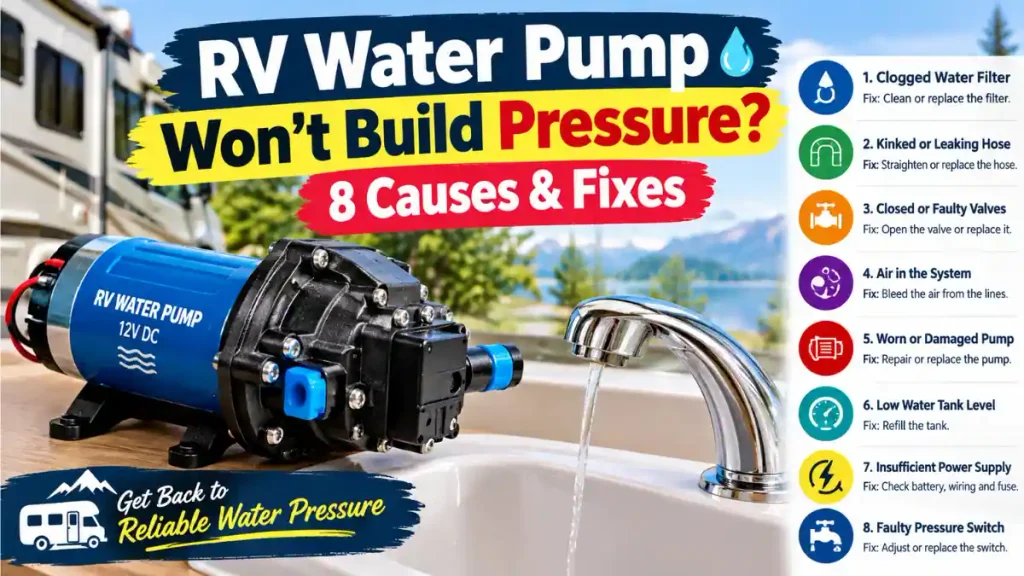
What If the RV Pump Won’t Build Pressure?
If the pump runs but cannot build enough pressure to shut off, the causes can overlap with the problems discussed in this guide.
Check the water supply, inlet, strainer, plumbing restrictions and leaks first.
Then inspect the pump’s check valve and pressure-switch operation according to the manufacturer’s specifications.
See:
RV Water Pump Won’t Build Pressure? 8 Causes & Fixes
Safety Before Working on an RV Water System
Before servicing the water pump or plumbing:
- Turn the pump off.
- Disconnect power when electrical service is required.
- Relieve water pressure before removing plumbing components.
- Protect electrical connections from water.
- Follow the pump manufacturer’s service instructions.
- Use the correct replacement fittings and seals.
- If working near propane appliances, follow the appliance manufacturer’s safety procedures.
- Never bypass a safety device simply to make the pump operate.
If you are unsure about an electrical or propane-related repair, use a qualified RV technician.
Final Takeaway
An RV water pump that keeps running does not automatically mean the pump is bad.
Start with the simple causes:
faucets → water supply → leaks → inlet → strainer → air → plumbing restrictions → check valve → pressure switch.
This approach helps identify whether the problem is actually the pump or something in the surrounding water system.
Diagnose the pressure problem first, then replace a component only when the evidence points to that component.
Frequently Asked Questions
Why does my RV water pump keep running when no faucet is open?
The system may be losing pressure because of a plumbing leak, leaking fixture, air entering the pump inlet, an internal check-valve problem or a pressure-switch issue.
How long should an RV water pump run?
The exact operating time depends on the system and pump model. A properly functioning pump should normally shut off after the water system reaches its specified shut-off pressure when fixtures are closed.
Why does my RV water pump keep cycling?
Repeated cycling usually means the system is losing pressure after the pump reaches its shut-off pressure. Check for small leaks, leaking fixtures and possible check-valve problems.
Can a clogged water filter make an RV pump keep running?
Yes. A severely restricted filter or inlet can reduce water flow and make it difficult for the pump to reach normal pressure.
Can an empty fresh-water tank damage an RV water pump?
Running a pump without an adequate water supply can cause problems depending on the pump design and operating conditions. Avoid running the pump dry and follow the manufacturer’s instructions.
Should I adjust the RV water pump pressure switch?
Do not adjust it blindly. Pressure-switch settings vary by pump model. Check the manufacturer’s specifications and service instructions first.
Related RV Water Pump Guides
- RV Water Pump Runs But No Water Comes Out? 9 Causes & Fixes
- RV Water Pump Won’t Build Pressure? 8 Causes & Fixes
More RV water-system troubleshooting guides will be added as new problems are published.