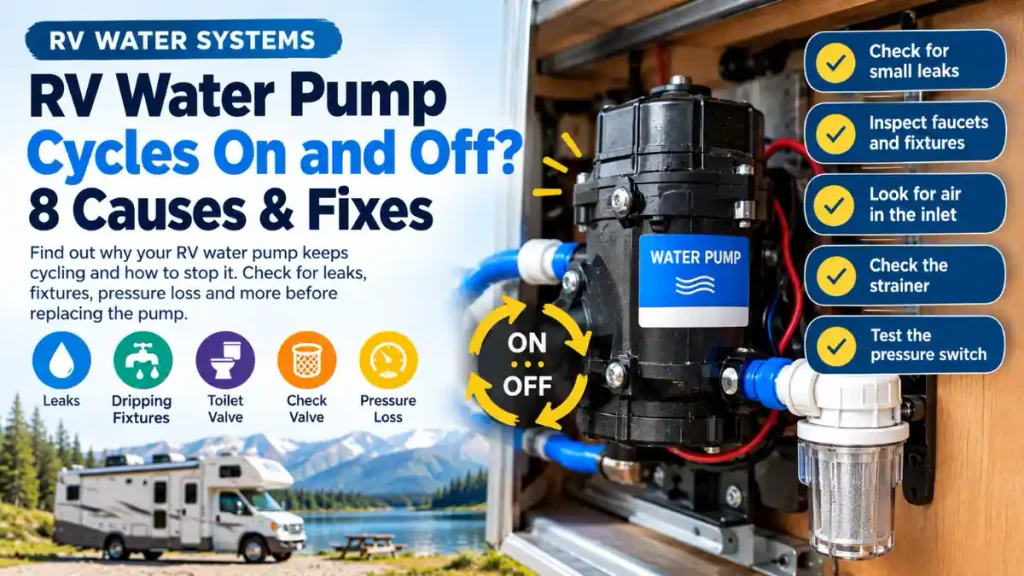
If your RV water pump keeps turning on and off even when no faucet is open, the system is usually losing water pressure somewhere.
This behavior is often called short cycling or pressure cycling. The pump builds pressure, shuts off, pressure drops, and then the pump starts again.
A small plumbing leak, dripping faucet, leaking toilet valve, faulty check valve or pressure problem can cause this.
Before replacing the pump, find out why the system is losing pressure.
Quick Answer
An RV water pump that cycles on and off with all faucets closed is commonly caused by:
- A small plumbing leak
- A dripping faucet or shower
- A leaking RV toilet valve
- A leaking exterior shower
- A water heater or plumbing connection leak
- A problem with the pump’s internal check valve
- Air entering the pump inlet
- A pressure-switch or pump-pressure problem
The easiest first test is to close every faucet and water fixture and listen to the pump.
If the pump shuts off but starts again after several seconds or minutes, the system is probably losing pressure.
What Does It Mean When an RV Water Pump Cycles?
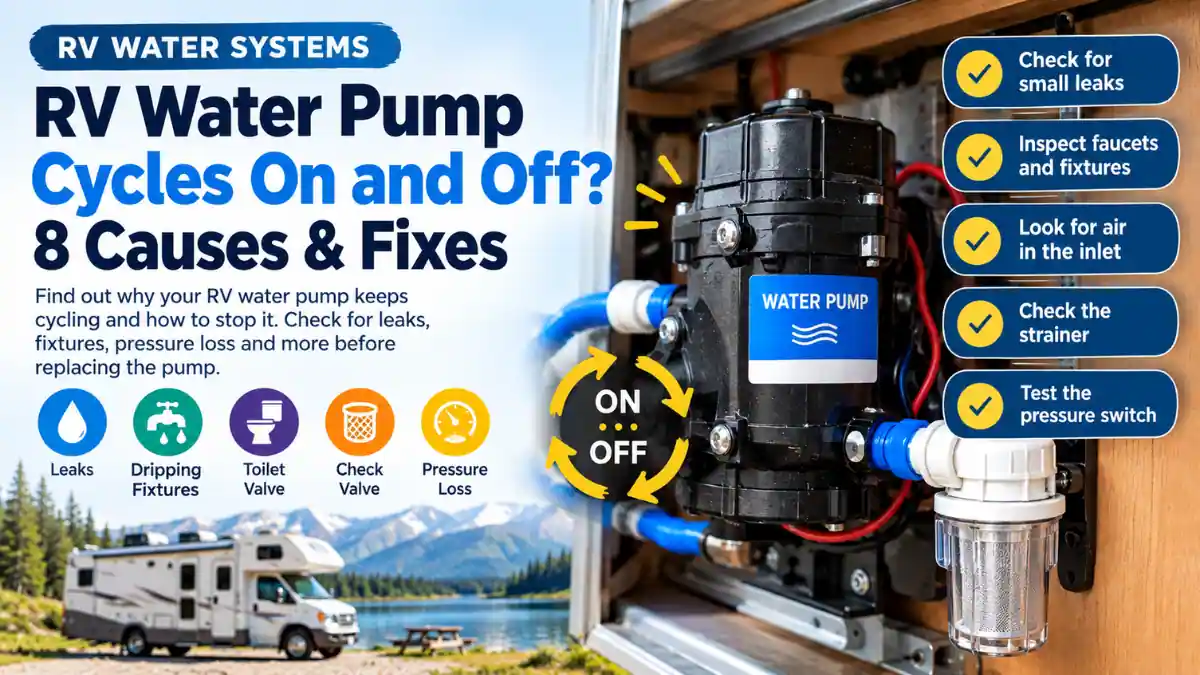
An RV water pump normally starts when water pressure falls and stops when pressure reaches the pump’s shut-off point.
For example:
Faucet opens → pressure drops → pump starts → pressure rises → pump stops.
When everything is closed, the system should normally maintain pressure.
If you hear:
Pump starts → runs briefly → stops → starts again → stops
without using water, something is causing the pressure to fall.
That does not automatically mean the pump motor is bad.
The first job is to determine where the pressure is going.
1. There Is a Small Plumbing Leak
A small leak is one of the first things to investigate.
You may not see a large puddle because RV plumbing can leak inside cabinets, underneath sinks or near fittings.
Even a small pressure loss can cause the pump to restart.
Check these locations
Inspect:
- Pump connections
- Fresh-water lines
- Faucet connections
- Shower plumbing
- Toilet supply connection
- Water heater connections
- Exterior shower
- Water filter housing
- PEX fittings
- Plumbing underneath sinks
- Connections near the fresh-water tank
Use a dry paper towel around suspicious fittings.
If the towel becomes wet, you have found a possible source of the pressure loss.
2. A Faucet Is Slowly Dripping
A faucet does not have to produce an obvious stream of water to cause pump cycling.
A small internal leak may allow enough water through the fixture to reduce system pressure.
Check every faucet carefully.
Look for:
- A slow drip from the spout
- Water leaking around the handle
- A loose connection underneath the sink
- A shower valve that is not completely closing
Close the fixture completely and watch whether the pump stops cycling.
3. The RV Toilet Valve Is Leaking
The toilet is another possible source of pressure loss.
A toilet valve that does not seal properly can allow water to slowly pass into the bowl.
The amount of water may be small enough that you do not immediately notice it.
Simple check
Inspect the toilet bowl after the system has been pressurized.
If water continues entering the bowl without flushing, the toilet valve may need attention.
Also inspect the toilet’s water connection for external leaks.
4. The Exterior Shower Is Not Fully Closed
Many RVs have an exterior shower fixture.
Because it may be outside the main living area, it is easy to forget about it.
Check that:
- Both handles are fully closed
- The shower head is not dripping
- The hose connection is not leaking
- The fixture is not damaged
If the exterior shower has a shut-off button on the shower head, do not assume that closing only that button completely isolates the fixture.
Check the actual faucet valves.
5. A Water Heater Connection Is Losing Pressure
Inspect the water heater plumbing connections for signs of leakage.
Depending on the RV and water-heater configuration, check around:
- Water inlet connections
- Hot-water outlet connections
- Bypass plumbing
- Relief-valve area
- Nearby fittings
Never remove or service a pressurized component without following the appliance manufacturer’s safety instructions.
If you find water around the water heater, determine whether it is coming from a plumbing connection or from the appliance itself.
6. The Pump’s Internal Check Valve Is Not Holding Pressure
The water pump contains internal components that help maintain pressure after the pump stops.
If the internal check valve does not hold pressure correctly, water pressure can fall back through the pump.
The result can look like this:
Pump runs → reaches pressure → stops → pressure falls → pump starts again.
If you have already ruled out external plumbing leaks, the pump’s internal check valve becomes a more likely possibility.
Do not replace the entire pump until external causes have been checked.
If the pump manufacturer provides service instructions for the check valve, follow those instructions for your specific model.
7. Air Is Entering the Pump Inlet
An air leak on the inlet side can cause unstable pump operation.
Unlike a normal water leak, an inlet-side air leak may not leave visible water.
Inspect the plumbing between the fresh-water tank and pump.
Pay particular attention to:
- Pump inlet fitting
- Strainer connection
- O-rings
- Hose connections
- Cracked tubing
- Loose fittings
If air is entering the system, the pump may have difficulty maintaining stable pressure.
8. The Pressure Switch or Pump Pressure Is the Problem
The pump uses a pressure switch to determine when it should start and stop.
If the pressure switch or pump pressure is not operating correctly, cycling may occur.
However, pressure-switch problems should usually be investigated after checking for leaks and other simple causes.
Before adjusting anything, check the pump manufacturer’s specifications.
Do not randomly turn the pressure-adjustment screw.
An incorrect setting can create additional problems.
How to Diagnose an RV Water Pump That Keeps Cycling
Follow this order.
Step 1: Close every faucet
Close the kitchen faucet, bathroom faucet and shower.
Make sure none are dripping.
Step 2: Check the exterior shower
Confirm that both valves are completely closed.
Step 3: Check the toilet
Look for water slowly entering the bowl.
Step 4: Listen to the pump
Does it:
- Stop for several minutes?
- Restart every few seconds?
- Run for a long time?
- Cycle only when a particular fixture is used?
The pattern can provide useful clues.
Step 5: Inspect for leaks
Check visible plumbing connections and use a dry paper towel around suspicious fittings.
Step 6: Check the water heater area
Look for wet fittings or plumbing connections.
Step 7: Inspect the pump inlet
Check the strainer, fittings, tubing and seals.
Step 8: Consider the pump’s internal check valve
If the external system appears leak-free but pressure still falls, investigate the pump itself.
Why Does My RV Water Pump Cycle Every Few Seconds?
Very frequent cycling deserves attention.
If the pump:
runs for a few seconds → stops → immediately starts again
there may be a significant pressure loss or a problem with the pump’s ability to maintain pressure.
Check for:
- Open or leaking fixture
- Plumbing leak
- Toilet valve leak
- Exterior shower leak
- Pump check-valve problem
- Inlet problem
- Pressure-switch issue
Do not leave the pump cycling continuously for long periods while trying to diagnose the problem.
Turn it off when the RV is not being used and investigate the cause.
Why Does My RV Water Pump Cycle Only Once in a While?
Occasional cycling can indicate a smaller pressure loss.
For example, the pump may remain off for several minutes and then briefly turn on.
Possible causes include:
- A very small plumbing leak
- A dripping fixture
- A toilet valve that does not seal completely
- A pump check valve slowly allowing pressure to fall
The longer the pump remains off before restarting, the smaller the pressure loss may be.
Still, unexplained cycling should be investigated.
RV Water Pump Cycling vs. Continuous Running
These symptoms are related but should not be treated as exactly the same problem.
Pump keeps running
The pump may be unable to reach its shut-off pressure.
Possible causes include:
- Major pressure loss
- Low water supply
- Restricted inlet
- Air entering the system
- Pump problem
- Pressure-switch problem
Pump cycles on and off
The pump reaches pressure but then loses it.
Possible causes include:
- Small plumbing leak
- Dripping fixture
- Toilet valve leak
- Exterior shower leak
- Check-valve problem
This distinction helps narrow the diagnosis.
Can a Water Filter Cause RV Pump Cycling?
A severely restricted filter can affect water flow and pump performance.
However, a filter restriction is not the first thing to blame when the pump is repeatedly cycling with all fixtures closed.
First check for actual pressure loss.
If the pump cycles only under certain flow conditions, inspect the filter and other restrictions as part of the diagnosis.
Should You Replace the RV Water Pump?
Not just because it cycles.
A pump that cycles may still be mechanically functional.
First determine whether pressure is being lost elsewhere.
Pump replacement becomes more reasonable when:
- External leaks have been ruled out
- Fixtures are sealing properly
- The pump inlet is in good condition
- The pump cannot maintain pressure
- The manufacturer’s troubleshooting procedure identifies an internal pump fault
- Repair is not practical for the particular pump
Replacing a good pump will not fix a leaking faucet, toilet valve or plumbing connection.
Quick Diagnostic Table
| What you notice | Possible cause | First check |
|---|---|---|
| Pump cycles every few seconds | Significant pressure loss | Check fixtures and plumbing |
| Pump cycles every few minutes | Small pressure loss | Look for slow leaks |
| Pump cycles after toilet use | Toilet valve problem | Check toilet bowl |
| Pump cycles after using exterior shower | Exterior shower leak | Check valves and hose |
| Pump cycles with no visible water leak | Internal check valve | Test pump/system |
| Pump cycles after plumbing work | Loose connection | Inspect fittings |
| Pump cycles after tank refill | Air or connection issue | Check pump inlet |
| Pump runs normally when faucet is open but cycles when closed | Pressure retention problem | Check leaks/check valve |
How to Stop an RV Water Pump From Cycling
The correct fix depends on the cause.
If you find a plumbing leak
Repair or replace the damaged fitting, tubing or component.
If a faucet is leaking
Repair or replace the faucet cartridge, valve or appropriate component.
If the toilet valve leaks
Service or replace the valve according to the toilet manufacturer’s instructions.
If the exterior shower leaks
Repair the valve or replace the damaged fixture.
If the pump inlet has an air leak
Repair the connection and make sure the seal is correctly installed.
If the check valve is failing
Follow the pump manufacturer’s service procedure or replace the pump if repair is not practical.
If the pressure switch is faulty
Use the manufacturer’s specifications to determine whether adjustment or replacement is appropriate.
What If the Pump Runs But Does Not Shut Off?
That is slightly different from cycling.
If your pump runs continuously and never reaches shut-off pressure, check:
- Fresh-water supply
- Pump inlet
- Strainer
- Air leaks
- Plumbing restrictions
- Water leaks
- Pump pressure
- Pressure switch
See our related guide:
RV Water Pump Keeps Running? 9 Causes & Fixes
What If the Pump Runs but There Is No Water?
If the pump motor runs but no water comes from the faucet, focus on the water supply and pump inlet rather than assuming the pressure switch is bad.
Check:
- Fresh-water tank
- Pump inlet
- Strainer
- Air leaks
- Valves
- Kinked water lines
See:
RV Water Pump Runs But No Water Comes Out? 9 Causes & Fixes
Safety Before Troubleshooting
Before working on the RV water system:
- Turn the water pump off.
- Relieve water pressure before disconnecting plumbing.
- Disconnect electrical power when servicing electrical components.
- Keep electrical connections dry.
- Follow the pump manufacturer’s instructions.
- Follow the RV manufacturer’s instructions for plumbing and water-heater service.
- Do not bypass pressure or safety devices.
- If the repair involves electrical wiring, propane equipment or a component you are not comfortable servicing, use a qualified RV technician.
Final Takeaway
An RV water pump that cycles on and off when no water is being used is usually telling you that system pressure is being lost.
Start with the simplest possibilities:
faucets → toilet → exterior shower → visible leaks → water heater connections → pump inlet → check valve → pressure switch.
Do not replace the pump until you know where the pressure is going.
A small leak or faulty fixture can cause the same symptom as a pump problem, and fixing that component may solve the issue without replacing the pump.
Frequently Asked Questions
Why does my RV water pump turn on by itself?
If the pump turns on when no faucet is open, the system may be losing pressure. Check for leaks, dripping fixtures, toilet-valve problems and pump check-valve issues.
How often should an RV water pump cycle?
When no water is being used, the pump should normally remain off after the system reaches its shut-off pressure. Repeated unexplained cycling indicates that pressure may be dropping.
Is it normal for an RV water pump to cycle occasionally?
A properly sealed system should not repeatedly cycle with no water demand. Occasional unexplained cycling is worth investigating because it can indicate a small pressure loss.
Can an RV toilet make the water pump cycle?
Yes. A toilet valve that does not close completely can allow water to pass and gradually reduce system pressure.
Can a leaking faucet make the RV pump turn on?
Yes. Even a small leak can reduce pressure enough to activate the pump.
Why does my RV pump cycle at night when nobody is using water?
A small pressure leak can become noticeable over time. Check faucets, toilet valves, exterior shower connections and plumbing fittings.
Will replacing the water pump stop cycling?
Only if the pump itself is causing the pressure loss. If the real problem is a faucet, toilet valve, plumbing leak or another component, replacing the pump will not solve it.
Related RV Water System Guides
- RV Water Pump Runs But No Water Comes Out? 9 Causes & Fixes
- RV Water Pump Won’t Build Pressure? 8 Causes & Fixes
- RV Water Pump Keeps Running? 9 Causes & Fixes
- RV Water Pump Cycles On and Off? 8 Causes & Fixes
More RV water-system troubleshooting guides will be added as new problems are published.