If your RV water pressure is too low, the problem may be caused by a clogged filter, restricted water line, low pump flow, a partially closed valve, a weak water supply or an issue with the RV plumbing system.
Low pressure does not always mean the water pump needs to be replaced.
The best approach is to determine whether the problem affects the entire RV or only one faucet. Then check the water supply, filters, valves, pump inlet and plumbing restrictions before replacing parts.
Quick Answer
Low RV water pressure is commonly caused by:
- A clogged faucet aerator or showerhead
- A clogged water filter
- A partially closed water valve
- A kinked or restricted water line
- A clogged pump strainer
- Low fresh-water tank supply
- Air entering the pump inlet
- A weak or failing water pump
- A restriction or problem in the RV plumbing system
If only one faucet has low pressure, start at that fixture.
If every faucet has low pressure, check the water supply, filter, pump and main plumbing system.
Why Is My RV Water Pressure So Low?
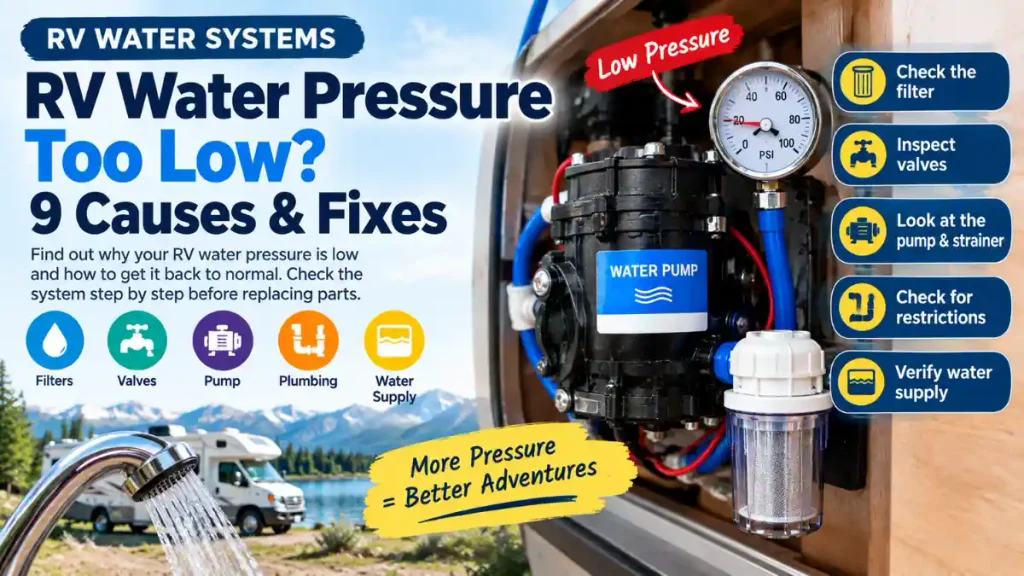
RV water systems rely on a combination of water supply, plumbing, valves and a pump when operating from the fresh-water tank.
When one part of that system becomes restricted, water flow can decrease.
The first question to ask is:
Is the low pressure happening at one fixture or throughout the entire RV?
That simple distinction can narrow the problem considerably.
If only one faucet is affected
The problem is more likely to be:
- Faucet aerator
- Faucet cartridge
- Showerhead
- Local plumbing restriction
- Fixture valve
If every faucet is affected
The problem may be:
- Fresh-water supply
- Water filter
- Pump
- Pump strainer
- Main water line
- Valve
- Plumbing restriction
1. The Faucet Aerator Is Clogged
If kitchen or bathroom water pressure suddenly becomes weak at one faucet, check the aerator first.
Mineral deposits and debris can restrict the small openings in the aerator.
What to do
Remove the aerator if the faucet design allows it.
Inspect it for:
- Sediment
- Mineral deposits
- Small debris
- Rust-colored particles
- White scale
Clean it and reinstall it.
Then test the faucet again.
Important clue
If removing or cleaning the aerator restores normal flow, the RV water pump probably was not the main problem.
2. The Showerhead Is Restricted
A shower can have noticeably lower flow than the kitchen sink because the showerhead itself is restricting the water.
Mineral deposits or debris can accumulate inside the small openings.
Check the showerhead
Remove it according to the manufacturer’s instructions and inspect the water passages.
If water flow improves substantially with the showerhead removed, the restriction is likely in the showerhead rather than the RV water system.
3. The RV Water Filter Is Clogged
A clogged water filter can reduce water flow throughout the RV.
This is especially important if:
- Pressure gradually became weaker
- The filter has been installed for a long time
- Water quality is poor
- The RV has recently been connected to a questionable water source
Check the filter
Inspect the filter housing and cartridge according to the filter manufacturer’s instructions.
Replace the cartridge when required.
Do not continue using a filter beyond its recommended service life.
Useful clue
If water pressure improves immediately after servicing the filter, the filter restriction was likely contributing to the problem.
4. A Water Valve Is Partially Closed
A partially closed valve can restrict flow.
This can happen after maintenance, winterization, plumbing work or storage.
Check accessible valves in the water system.
Depending on the RV, inspect:
- Fresh-water supply valve
- Pump inlet valve
- Water-heater bypass valves
- Filter bypass
- Other plumbing shutoff valves
Make sure the correct valves are in the proper operating position for your RV.
Important
Do not randomly change water-heater bypass or winterization valve positions.
Valve configurations vary between RVs.
Use your RV owner’s manual when you are unsure about the correct position.
5. The Pump Strainer Is Clogged
When operating from the fresh-water tank, the water pump draws water through its inlet.
Many RV pumps have an inlet strainer designed to catch debris before it reaches the pump.
If the strainer becomes restricted, water flow can decrease.
Check the strainer for:
- Sediment
- Dirt
- Plastic debris
- Mineral deposits
- Other visible material
Turn the pump off and relieve pressure before servicing the strainer.
Clean or replace the strainer according to the pump manufacturer’s instructions.
Make sure the seal and connections are properly installed when reassembling it.
6. The Fresh-Water Tank Is Low
If you are using the RV’s fresh-water tank, check the water level.
A very low tank can cause water-supply problems.
The pump cannot provide normal water flow if it is not receiving an adequate supply.
Check the tank
Make sure the fresh-water tank contains sufficient water.
Then test several fixtures.
If pressure returns after restoring the water supply, the low tank level was likely contributing to the problem.
7. Air Is Entering the Pump Inlet
An inlet-side air leak can affect pump performance.
Unlike a normal plumbing leak, an air leak on the suction side may not leave visible water.
Inspect the plumbing between the fresh-water tank and pump.
Look closely at:
- Pump inlet fittings
- Strainer connection
- O-rings
- Tubing
- Hose connections
- Cracked or damaged sections
An improperly sealed inlet connection can allow air to enter the system and reduce pump performance.
8. The Water Pump Is Weak or Failing
If every faucet has low pressure and the water supply, filter, valves, strainer and plumbing appear normal, the pump may need further investigation.
Possible pump-related problems include:
- Internal wear
- Damaged components
- Check-valve problems
- Pressure-switch problems
- Restricted inlet
- Motor or electrical problems
However, do not replace the pump simply because pressure feels low at one faucet.
First determine whether the restriction is local to that fixture or affects the entire system.
If the pump has a model-specific troubleshooting procedure, use the manufacturer’s specifications to test its operation.
9. There Is a Restriction in the RV Plumbing
A damaged or restricted water line can reduce flow.
Inspect accessible plumbing for:
- Kinks
- Pinched tubing
- Crushed lines
- Damaged fittings
- Debris
- Improperly installed connections
If the pressure problem began after plumbing work, modification or winterization, pay particular attention to areas that were recently disturbed.
Low Pressure at One Faucet vs. the Whole RV
This is one of the most useful diagnostic clues.
| Symptom | More likely area to inspect |
|---|---|
| Only kitchen faucet is weak | Faucet aerator or faucet valve |
| Only shower is weak | Showerhead or shower valve |
| Only bathroom faucet is weak | Aerator or local plumbing |
| All faucets are weak | Filter, pump, supply or main plumbing |
| Tank mode is weak but city water is normal | Pump, tank supply or pump inlet |
| City water is weak but pump mode is normal | External water supply, regulator or inlet |
| Both tank and city water are weak | Common plumbing restriction or fixture problem |
This comparison can help prevent unnecessary pump replacement.
RV Water Pressure Low on Fresh-Water Tank but Normal on City Water
If the RV has normal pressure when connected to city water but low pressure when using the fresh-water tank, the problem is more likely to be on the tank/pump side.
Check:
- Fresh-water tank level
- Pump inlet
- Pump strainer
- Inlet tubing
- Air leaks
- Pump operation
- Pump pressure
The city-water system can bypass the RV’s water pump, which makes this comparison particularly useful.
RV Water Pressure Low on City Water but Normal on Pump
If pressure is normal when using the pump but weak when connected to city water, inspect the city-water side.
Possible areas include:
- External water supply
- RV drinking-water hose
- Inline filter
- Pressure regulator
- City-water inlet
- Inlet screen
Check the components in the order recommended by the RV and equipment manufacturers.
How to Diagnose Low RV Water Pressure
Follow this sequence.
Step 1: Determine whether every fixture is affected
Test:
- Kitchen faucet
- Bathroom faucet
- Shower
- Other accessible water outlets
If only one is weak, start at that fixture.
If all are weak, continue with the system-level checks.
Step 2: Check the water source
If using the fresh-water tank, check the tank level.
If using city water, check the external water supply and connection.
Step 3: Check the filter
A clogged filter can restrict the entire system.
Step 4: Check valves
Make sure the appropriate water valves are fully open and correctly configured.
Step 5: Check the pump strainer
Inspect for debris or restriction.
Step 6: Inspect the pump inlet
Look for loose fittings, damaged tubing or possible air leaks.
Step 7: Inspect visible plumbing
Look for kinks, restrictions and damaged connections.
Step 8: Evaluate the pump
If the entire system remains weak after the other checks, investigate the pump according to its manufacturer’s troubleshooting procedure.
How to Improve RV Water Pressure
The correct solution depends on the cause.
Clean a clogged aerator
If only one faucet is affected, clean or replace the aerator.
Clean or replace a restricted showerhead
If the shower is the only problem, service the showerhead.
Replace a clogged filter
Use the correct filter and follow the manufacturer’s replacement instructions.
Correct a valve position
Return the valve to the correct operating position for your RV.
Clean the pump strainer
Remove debris and make sure the strainer is correctly sealed.
Repair restricted plumbing
Correct kinks, damaged tubing or faulty fittings.
Repair an inlet air leak
Secure the connection and replace damaged seals or tubing where necessary.
Service or replace the pump
Only consider pump replacement after the rest of the system has been checked.
Can a Water Pressure Regulator Cause Low RV Water Pressure?
Yes, when using city water.
An RV pressure regulator is intended to control incoming water pressure, but a regulator that is incorrectly set, restricted or malfunctioning can affect water flow.
If city-water pressure is low throughout the RV, inspect the regulator and city-water connection according to the manufacturer’s instructions.
Do not assume that a weak pump is responsible when the RV is operating from city water.
Can an RV Water Pump Provide More Pressure?
The pump can only operate within the limits of its design and specifications.
If the pump is functioning correctly, changing random adjustments is not a good first step.
Before attempting to change pump pressure, check:
- Pump model
- Manufacturer specifications
- Pressure-switch settings
- Water supply
- Inlet restriction
- Plumbing restrictions
Never exceed the pressure limits specified for the RV plumbing system or individual components.
Should You Replace the RV Water Pump for Low Pressure?
Not automatically.
A pump replacement makes sense only when testing indicates that the pump is unable to perform according to its specifications and other likely causes have been ruled out.
Before replacing it, check:
- Water supply
- Filter
- Valves
- Pump strainer
- Pump inlet
- Air leaks
- Plumbing restrictions
- Fixture restrictions
A clogged filter or faucet aerator can create a low-pressure symptom without any pump failure.
RV Water Pressure Troubleshooting Table
| Problem | Likely area | First action |
|---|---|---|
| One faucet has low pressure | Aerator or faucet | Clean aerator |
| Shower has low pressure | Showerhead | Inspect showerhead |
| All fixtures weak on tank water | Pump system | Check tank, strainer and inlet |
| All fixtures weak on city water | City-water side | Check hose, regulator and inlet |
| Pressure gradually decreased | Filter or restriction | Check filter |
| Pressure became weak after maintenance | Valve or plumbing | Check recently serviced areas |
| Pump sounds different | Pump/inlet | Inspect pump supply |
| Pump cycles while pressure is low | Pressure loss | Check leaks and pump system |
| Water flow is weak after tank refill | Air or inlet issue | Check pump inlet |
When Low Water Pressure May Be a Bigger Problem
Some symptoms deserve more attention than a simple clogged aerator.
Investigate promptly if you notice:
- Water leaking inside cabinets
- Water accumulating underneath the RV
- A pump running continuously
- A pump repeatedly cycling
- Electrical components becoming wet
- A water heater leak
- Damaged plumbing
- A sudden major loss of water pressure
Turn off the water pump when necessary to prevent unnecessary operation while investigating a leak.
Safety Before Working on the RV Water System
Before servicing RV plumbing:
- Turn off the water pump.
- Relieve water pressure before disconnecting plumbing.
- Disconnect electrical power when servicing electrical components.
- Keep electrical connections dry.
- Follow the RV manufacturer’s instructions.
- Follow the pump manufacturer’s service instructions.
- Use replacement components that are compatible with the system.
- Never exceed the pressure rating of the plumbing or components.
- If you are not comfortable working on electrical, propane or pressurized equipment, use a qualified RV technician.
What If Your RV Water Pump Runs but Pressure Is Still Low?
If the pump runs but the water pressure remains weak, start by determining whether the pump is actually receiving enough water.
Check:
Fresh-water tank → pump inlet → strainer → pump → plumbing → fixtures
If the pump cannot receive an adequate water supply, replacing it may not solve the problem.
If the supply is good and the pump still cannot produce the pressure specified for its model, investigate the pump itself.
Related RV Water Pump Problems
If your symptom is different from low water pressure, one of these guides may be more relevant:
RV Water Pump Runs But No Water Comes Out
Check the fresh-water supply, inlet, strainer, air leaks and valves when the pump runs but little or no water reaches the faucet.
RV Water Pump Won’t Build Pressure
If the pump runs continuously but cannot reach normal shut-off pressure, troubleshoot pressure loss, inlet restrictions, leaks and pump operation.
RV Water Pump Keeps Running
If the pump never shuts off after all faucets are closed, check for leaks, air entering the inlet, restrictions and pressure-switch problems.
RV Water Pump Cycles On and Off
If the pump repeatedly starts and stops when nobody is using water, investigate pressure loss and possible leaks.
Frequently Asked Questions
Why is my RV water pressure suddenly low?
A sudden drop can be caused by a clogged filter, blocked aerator, partially closed valve, kinked water line, pump inlet problem or another restriction.
Why is my RV shower pressure so low?
If other faucets have normal flow, inspect the showerhead and shower valve first. Mineral deposits or debris can restrict the showerhead.
Why does my RV have low pressure at every faucet?
When every fixture is affected, investigate the water source, filter, valves, pump strainer, pump inlet and main plumbing system.
Why is my RV water pressure low on the fresh-water tank?
Check the tank level, pump inlet, strainer, inlet tubing and pump operation. An air leak or restriction before the pump can reduce water flow.
Why is my RV water pressure low on city water?
Check the city-water hose, filter, pressure regulator and RV city-water inlet. The external water supply may also be contributing to the problem.
Can a clogged RV water filter reduce pressure?
Yes. A restricted filter can reduce water flow throughout the RV.
Can a bad water pump cause low RV water pressure?
Yes, but the pump should not be the first component blamed. Rule out water-supply, filter, valve, strainer, inlet and plumbing problems first.
Should I install a stronger RV water pump?
Do not select a pump simply because it has a higher pressure rating. The replacement pump must be compatible with the RV plumbing system and the manufacturer’s specifications.
Final Takeaway
Low RV water pressure does not automatically mean you need a new water pump.
Start by asking whether the problem affects one fixture or the entire RV.
Then work through the system:
fixture → filter → valves → water supply → pump strainer → pump inlet → plumbing → pump.
Finding the restriction before replacing a component can save both time and money.
The goal is simple:
Diagnose the water system first. Replace the part only when testing shows that it has actually failed.